
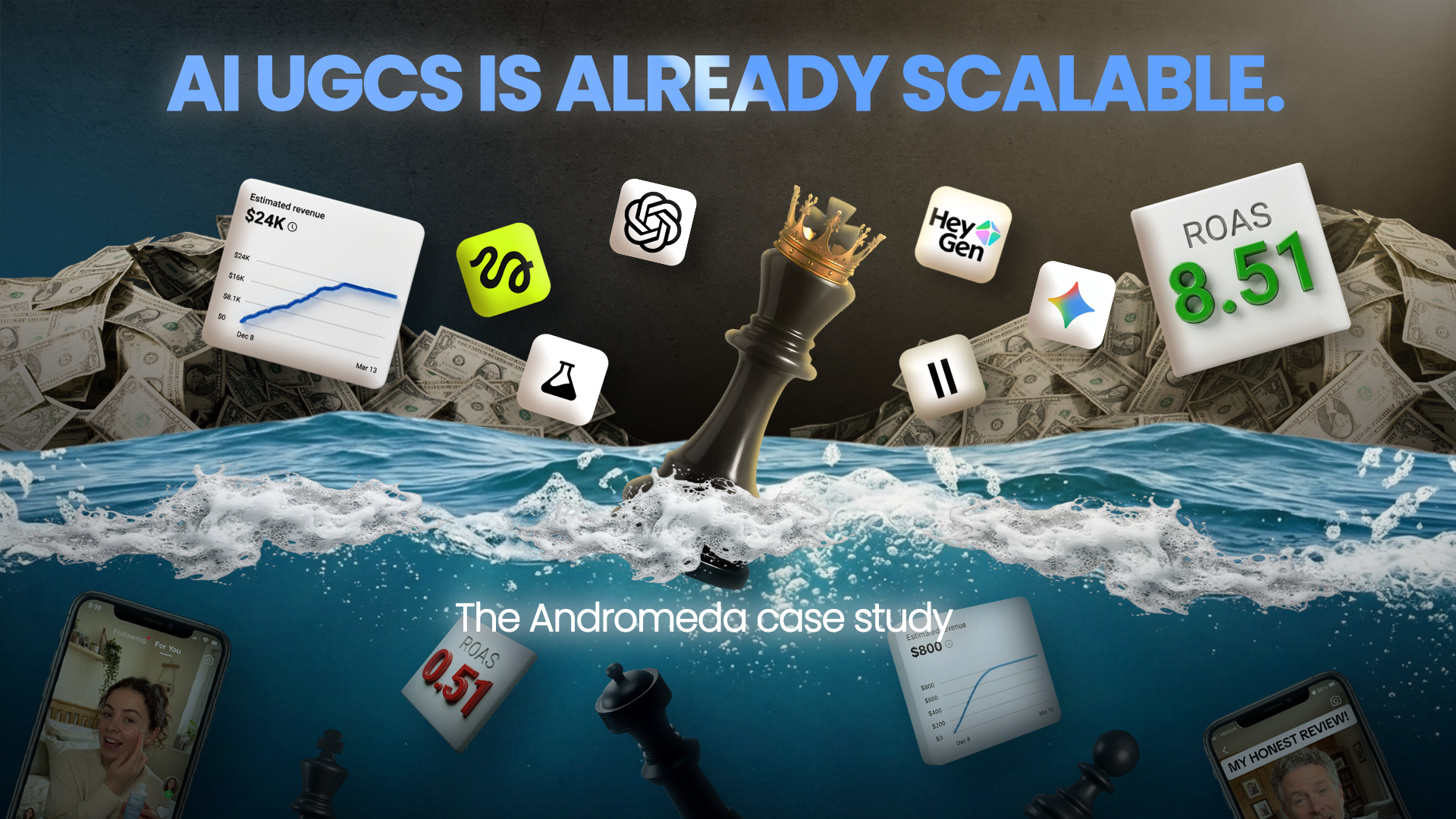
Short answer. Real UGC is not dying. For paid performance at scale, it is already dead. Not because people stopped trusting creators, but because Meta now demands more fresh, different creative every week than any human UGC pipeline can ship. AI UGC already clears that bar, and the brands who switched are not waiting for permission. This is the full playbook we run, written so you can run it too.
Quick disclaimer. Real UGC is not literally dead. Real creators and authentic content still work, and we still use them where they fit. The claim is narrower and on purpose: as the engine of paid performance at the volume and speed Meta Andromeda now rewards, a purely human UGC pipeline cannot keep pace. AI UGC is how we hit that cadence. Read the headline as a provocation about scale, not a eulogy for creators.
Real UGC is not dying. It is already dead.
Let me be specific, because this gets said badly. People still trust creators. First-person, native, phone-shot content still converts better than a polished studio spot. None of that died. What died is real UGC as the engine of paid performance at scale, and it died for one reason: math.
Meta now rewards ten to fifty genuinely different concepts, refreshed every week, because that is what its retrieval engine feeds on. Real UGC cannot move at that speed. A single batch means briefing creators, shipping product, waiting for footage, chasing revisions and editing. That is a two to four week loop, per batch, with a creator fee on every new angle. By the time the content lands, fatigue has already hit the last winner and the window has moved. You cannot feed a weekly-hungry algorithm on a monthly human pipeline.
AI UGC is not worse UGC. It is the same emotional, native, first-person format, produced in an afternoon instead of a month, in the volume and diversity the algorithm actually rewards. That is the whole gap between a ROAS of 0.51 and a ROAS of 8.51. It is not that one creator was better. It is that one brand could feed the machine fresh, distinct creative every week and the other could not. Here is the strategy that makes AI UGC scale.
Why Andromeda changed the game in 2026
Meta Andromeda, rolled out globally by late 2025, is the retrieval engine that decides which ads even get a chance to reach you. Before an ad hits the auction, Andromeda narrows tens of millions of candidates down to a few thousand relevant ones per person, then ranks them. It runs on serious hardware built for massive model capacity, and the practical effect is simple: the lever moved from targeting precision to creative input quality and breadth. In Meta's own framing, if you do not provide diversity, the AI has nothing to work with.
So in 2026 your creative library is the core signal. Andromeda rewards portfolios of ten to fifty distinct concepts over minor variations, and accounts that adapt are seeing meaningful gains in ad quality, lower CPMs and lower CPAs. Accounts that keep running three hero ads and heavy interest targeting are watching costs climb and blaming the platform. The platform changed. Their strategy did not.
The five insights shaping Meta in 2026
1. Creative diversity beats creative perfection
Andromeda rewards ten to fifty genuinely distinct concepts, not fifty tweaks of one ad. Your edge now comes from volume, speed and hypothesis-led iteration, not from one over-polished hero. A brand with three angles has three doors into its market. A brand with thirty has thirty. Same market, far more demand unlocked.
2. AI and modular systems are now the default
Advantage+ creative keeps pushing toward full automation. You give it a product and a budget, and the system generates and remixes hooks, visuals and combinations at a scale no manual team can match. Manual, one-by-one creation cannot keep up. The winners in 2026 run AI-assisted workflows, modular templates and auto-refresh systems that feed Andromeda new signals every single week.
3. Platform-native feel wins
Ads that look like organic content, Reels and Stories, beat polished commercials. The first three seconds decide everything, because that is where you either beat the scroll or lose. With CPMs rising, vertical layouts and native captions hold attention far better than horizontal, studio-looking spots.
4. Volume over perfection is a law, not a style
Around eighty percent of creatives flop. The twenty percent that win come from testing distinct hypotheses, different pains, different outcomes, different people. Rotate every seven to fourteen days to beat fatigue. Grouping fifteen or more modular formats per set is what earns the algorithm's favor and lets spend grow without CPA spiking.
5. Full-funnel, all at once
Top of funnel uses storytelling and emotional hooks. Middle of funnel layers social proof and credibility. Bottom of funnel brings urgency and value clarity. You deploy for every stage at the same time, not just your winners. And because attribution has shifted, lean on seven-day click models and first-party data or you will misread what is actually working.
The 7 formats that print in 2026
Aim for a fifty-fifty video and static split in testing. Start around fifty to one hundred dollars per day per creative in broad audiences, then scale winners. Here is the mix we rotate.
| Format | Best for | Hook time | ROAS potential |
|---|---|---|---|
| Problem-Agitation-Solution video | TOF, cold acquisition | Under 5s | 2.5 to 3.5x |
| Before and after static | MOF, retargeting | Instant | 2 to 4x |
| Storytelling UGC reel | Full funnel | 3 to 7s | 3 to 5x |
| Testimonial quote static | MOF, social proof | Instant | 2.8 to 4x |
| Bold typography with numbers | Full funnel, value | Instant | 2.5 to 4x |
| Product showcase static | TOF, product curiosity | Instant | 2 to 3.5x |
| Bullet benefit cascade | Full funnel, desire | Instant | 2.8 to 4x |
Problem-Agitation-Solution video
Why it wins: it builds curiosity with a relatable frustration, then delivers an instant visual payoff. Done right it hits hook rates far above the fifteen to twenty percent baseline and frames your product as the effortless unlock. How to build it: Hook (0 to 3s) show the exaggerated problem. Agitate (3 to 7s) amplify it with quick cuts. Solve (7 to 15s) a dramatic reveal of the product. CTA overlay "fix it now." Keep it fifteen to thirty seconds, vertical, music building from tension to resolution. Test three pain points per batch.
Before and after static
Why it wins: instant visual contrast builds trust, and static still makes up most DTC winners despite the hype for video. It mimics the proof of a review and can cut CPA sharply. How to build it: split image, dull before on the left, vibrant after on the right. Top safe zone text "from [pain] to [win] in 7 days." One-to-one square for the feed. Batch ten, varying lighting and emotion.
Storytelling UGC reel
Why it wins: it feels like a friend venting, which pulls people in emotionally and routinely outperforms scripted ads. How to build it: conversational hook, "let me tell you a story," then a three-act arc of problem, journey and win shot on a phone, with subtle product integration and a soft "your turn?" CTA. Fifteen to twenty seconds, raw and unscripted, text pops on key lines.
Testimonial quote static
Why it wins: social proof drives trust and conversions without the load time of video, and Andromeda reads quote signals for credibility matching. How to build it: quote bubble with an avatar and stars, a real pulled quote and a subtle product, CTA "see more reviews." One-to-one, clean sans-serif. Test five quote types from short punches to mini-stories.
Bold typography with numbers
Why it wins: big stats and prices cut through the feed with specificity and contrast, lifting CTR and average order value. How to build it: vibrant background, giant numbers like "50% off, save $50 now," one or two supporting lines and icons, urgent CTA. Test four number variants, discounts against stats.
Product showcase static
Why it wins: centering the product drives instant recognition and desire, with lower CPC than cluttered images. How to build it: product on a clean, minimal background taking most of the frame, subtle shadows for depth, a top badge like "No.1 recommended," one or two benefits and a "shop now" CTA. One-to-one, high resolution. Test three angles and lighting setups.
Bullet benefit cascade
Why it wins: layered bullets cascade desire and awareness, giving Andromeda dense signals for micro-matching while icon variety keeps it fresh. How to build it: a top hook question, then three or four benefits with icons, "no crash, 2x focus, tastes great," and a bottom "start now." Test three cascades, each built around a different desire.
The 7-day testing blueprint
Structure beats guessing. Run ad-set budget optimization for testing and let winners prove themselves before you migrate them to automated scaling.
Setup: two ad sets, broad and retarget, with three to five creatives each, around forty dollars a day adjusted for rising CPMs. Variables: test one element at a time, hook against CTA, across formats. Kill rules: pause anything under 1.5 ROAS only after it has gathered real conversions, roughly fifty, then rotate weekly. Read the leading metrics first: three-second hook rate above twenty percent, CTR above 1.4 percent, then blended ROAS with lifetime value folded in. Scale trigger: 2x ROAS and around one hundred conversions, then bump budgets twenty to thirty percent every few days so you never throw an ad set back into learning.
Common pitfalls that quietly drain budget
Over-segmentation. Narrow audiences starve Andromeda of signal and slow learning. Go broad first and let the creative do the targeting. Creative fatigue. Winners decay within two weeks. Rotate three to five per set, watch per-ad ROAS not just campaign level, and refresh weekly. Ignoring attribution. One-day view ROAS flatters you. Default to seven-day click and layer in your own backend data. Slow landing pages. Every second over two seconds bleeds buyers, so the page has to carry the ad's promise fast. Manual over automation. Hand-building a few ads a week cannot feed the machine. Killing ads too soon. Some slow starters scale later, so judge at the portfolio level once there is enough spend to be real.
The 30-day roadmap
Phase 1, audit and foundation (week 1): review your top ten percent of performers, fix server-side tracking and seven-day click alignment, and reset to one broad campaign with light exclusions. Phase 2, portfolio build (weeks 1 to 2): generate twelve to twenty distinct concepts across angles, personas and formats, and load fifteen to thirty into the account. Phase 3, test and feed (weeks 2 to 4): launch two to three formats per funnel stage, kill under 1.5 ROAS after real conversions, and feed performance data back into your next batch. Phase 4, scale and sustain: duplicate winners, bump budgets in steps, and churn the library monthly so fresh creative always enters before the old winners fade.
In one line
If 2025 was about targeting, 2026 is about feeding Andromeda enough diverse, emotionally intelligent creative to match millions of micro-audiences, consistently, systematically and at the speed only AI makes possible. That is the entire game, and it is exactly what we built KONNVERT to run.